 Skip to content
Choosing a new dog is a fifteen-year commitment, and the wrong energy match can feel like a daily struggle. Are you looking for a running partner or a couch co-pilot? Answering that one question is the first and most important step in deciding between the ever-popular Goldendoodle and the charming Bernedoodle.
Think of each dog’s personality as a recipe, with the parent breeds providing the core ingredients. The classic Goldendoodle temperament gets its social, life-of-the-party energy from its Golden Retriever side—a breed famous for being endlessly playful and friendly with strangers. In practice, this often creates an exuberant and outgoing companion.
The Bernedoodle temperament, however, draws from the Bernese Mountain Dog, a famously calm and loyal “gentle giant” from the Swiss Alps. This heritage typically produces a more laid-back, watchful dog that tends to be exceptionally devoted to its family. While both share the Poodle’s remarkable intelligence, this fundamental difference in their “recipe” is the key to finding which dog will truly fit your life.
Playful Pal vs. Cuddly Companion: Which Temperament Fits Your Family?
Beyond the fluffy coats and happy smiles, the most significant difference between these two doodles is their core personality. Thinking about your family’s social life is the best way to start. Do you host frequent get-togethers and want a dog that will greet every guest with a wagging tail, or do you prefer a quieter home and a dog who is more devoted to its inner circle?
The Goldendoodle temperament is often described as the “life of the party.” By blending the famously outgoing nature of a Golden Retriever with the Poodle’s intelligence, you get a dog that rarely meets a stranger. They are typically social, exuberant, and thrive in active, busy households. This eager-to-please attitude makes them highly trainable and endlessly charming.
In contrast, the Bernedoodle tends to be the calmer, more devoted homebody. Drawing from the loyal and gentle nature of the Bernese Mountain Dog, they often form incredibly deep bonds with their family but can be more reserved around newcomers. This isn’t unfriendliness, but rather a loving loyalty reserved for their people. Many owners find their sweet, sometimes goofy, and cuddly nature a perfect fit for a family-focused life.
Both breeds can be exceptional companions, as a dog’s individual temperament and early socialization are often more important than its breed mix alone. A well-socialized Bernedoodle can be just as gentle with kids as a Goldendoodle. The choice comes down to whether you want a social butterfly or a loving shadow, and this difference in social style connects directly to their physical energy.
Running Partner or Couch Co-Pilot? Matching a Doodle’s Energy to Your Lifestyle
The Goldendoodle, inheriting the athleticism of the Golden Retriever and Poodle, is a born adventurer. Their energy needs typically go beyond a simple stroll around the block; think daily runs, vigorous games of fetch, or trips to the dog park to truly burn off steam. An under-exercised Goldendoodle can quickly become a bored one, channeling its pent-up energy into chewing or barking. They are fantastic partners for active individuals or families ready to make daily, dedicated playtime a priority.
The Bernedoodle is generally the calmer of the two. While they absolutely need and enjoy daily walks and mental stimulation, they don’t typically demand the same high-octane exercise as a Goldendoodle. Their Bernese Mountain Dog heritage lends them a more laid-back demeanor. A Bernedoodle is often perfectly content with a good walk followed by a long nap at your feet, making them an excellent match for households with a more moderate pace of life.
Choosing based on energy requires an honest self-assessment. Are you looking for a dog to join you on your morning jogs, or one who will happily greet you at the door and then settle on the rug? This difference in activity needs also relates to the physical space they require.
From Tiny Teddies to Gentle Giants: Will a Bernedoodle or Goldendoodle Fit in Your Home?
A dog’s energy level is one piece of the puzzle, but their physical size is another crucial factor for your living space. Fortunately, both Bernedoodles and Goldendoodles are bred in a range of sizes. Most breeders use three general categories, though the exact weights can vary:
- Standard: 50 to 90+ pounds
- Miniature: 25 to 45 pounds
- Toy/Micro: 10 to 24 pounds
While those weight ranges overlap, the key size difference lies in their build. Thanks to their Bernese Mountain Dog heritage, Bernedoodles are typically stockier and heavier-boned. A 60-pound Bernedoodle might look much broader than a 60-pound Goldendoodle, which often has a leaner, more athletic frame. If you’re considering a Standard size, be prepared for a Bernedoodle to be a truly large dog.
Beyond the space they occupy, a larger dog also means a larger budget. Everything from the average cost of food and vet bills to grooming appointments scales up with size. The upkeep of their fluffy coat is a major consideration for both breeds.
The Truth About ‘Hypoallergenic’ Coats: Grooming, Shedding, and Your Budget
The “hypoallergenic” label is a common point of interest, but the simple answer is that no dog is 100% hypoallergenic. Allergens are carried in dander (dead skin cells) and saliva, not just hair. The real goal for allergy sufferers is to find a low-shedding dog. While Poodles have low-shedding coats, crossing them with a shedding breed like a Golden Retriever or Bernese Mountain Dog means the outcome isn’t guaranteed.
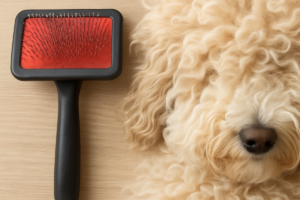
That beautiful, fluffy coat comes with a serious commitment: daily brushing. Without it, their soft fur can quickly develop painful knots called mats, which pull tightly on the skin and can lead to irritation and infections. A simple slicker brush is your best friend, and spending 10-15 minutes each day preventing tangles is far kinder and easier than trying to remove mats once they’ve formed.
Beyond your daily efforts, professional grooming is a non-negotiable expense. Both Bernedoodles and Goldendoodles need a full haircut from a professional groomer every 6 to 8 weeks to prevent their coat from becoming an unmanageable mess. Factoring this recurring cost into your budget is crucial, as a professional groom for a large doodle can easily cost $100 or more per visit.
Neither breed has a clear advantage in shedding, as the coat type depends on the genetics of the individual puppy. However, breeders use generation labels like ‘F1’ and ‘F1b’ to help predict a puppy’s coat type.
What Do ‘F1’ and ‘F1B’ Mean? A Simple Guide to a Lower-Shedding Puppy
When you start looking at puppies, you’ll see codes like “F1” and “F1B.” These generation labels tell you how the puppy was bred, which helps predict its coat. An F1 doodle is a first-generation, 50/50 mix between a purebred Poodle and a purebred Golden Retriever or Bernese Mountain Dog. This cross is a genetic lottery—the puppy could have a wavy, low-shedding coat or a straighter, shedding coat.
To increase the odds of getting an allergy-friendly coat, breeders produce an F1B generation by breeding an F1 doodle back to a purebred Poodle. The resulting puppy is roughly 75% Poodle and 25% retriever or mountain dog. This F1B generation is the most reliable choice for families prioritizing a low-shedding, more classically “doodle-looking” dog.
Understanding these generations gives you more control over finding the right fit, which is just as important as understanding the potential health of your future companion.
Health & Lifespan: What to Expect for a Long, Happy Life Together
The concept of hybrid vigor suggests that mixing two purebreds creates a healthier dog, but it’s not a golden ticket to perfect health. Both Bernedoodles and Goldendoodles can inherit problems from their parent breeds. One shared concern is hip dysplasia, a painful genetic joint condition. A responsible breeder will screen for this, but it’s a potential risk in both doodle types.
The biggest health differences trace back to their non-Poodle parent. Golden Retrievers carry a known risk for certain types of cancer, which can be passed to Goldendoodles. The Bernese Mountain Dog, however, has a significantly shorter average lifespan and a higher rate of aggressive cancers. Because of this, a Goldendoodle may live 10 to 15 years, while a Bernedoodle’s lifespan is often closer to 7 to 12 years. Both standard-sized doodles are also at risk for bloat, a sudden and life-threatening stomach condition.
This isn’t meant to be alarming, but to highlight the importance of choosing a reputable breeder who performs health screening on their parent dogs. This means they test for genetic issues like hip dysplasia and can provide proof of clear results. Asking for these clearances is your best insurance policy for a long, happy life together. This focus on health is a critical part of the initial investment in your new family member.
Trainability and Puppy Price: Understanding the Full Investment
Thanks to their Poodle parent, both breeds are incredibly intelligent. This intelligence shapes their trainability in slightly different ways. A Goldendoodle often inherits the Golden Retriever’s classic eagerness to please, making them fantastic for first-time owners. Bernedoodles are just as clever but can have a stubborn streak from their Bernese Mountain Dog side. They respond beautifully to training but might first wonder, “What’s in it for me?”, requiring more patience and consistent motivation.
The upfront cost of your puppy often reflects the breeder’s investment. The average cost for a Bernedoodle or Goldendoodle typically falls between $1,500 and $4,000. A price that seems too good to be true often is—frequently serving as a red flag for puppy mills or breeders who skip crucial health checks.
Reputable breeders invest heavily in health screening the parent dogs for the very issues we discussed, a cost passed on to ensure a healthier pup. Factors like unique coat colors (especially the classic tri-color Bernedoodle), specific generations like the F1B, and the breeder’s reputation all play a role. Viewing the price as an investment in a healthy, well-bred dog sets the stage for a long and happy life together.
At a Glance: A Side-by-Side Cheat Sheet for Your Final Decision
To simplify your decision in the Bernedoodle vs. Goldendoodle debate, here’s a quick side-by-side comparison of their core traits.
| Trait | Goldendoodle | Bernedoodle | | :— | :— | :— | | Temperament | Outgoing, social, and eager-to-please | Calm, loyal, and sometimes a bit goofy | | Energy Level | High; needs daily vigorous exercise | Moderate; enjoys walks and playtime | | Avg. Standard Size | 50-80 lbs | 70-90+ lbs | | Grooming Needs | High; requires daily brushing | High; requires daily brushing | | Avg. Lifespan | 10-15 years | 7-12 years | | Best For… | Active families who love adventure | Families seeking a laid-back companion |
Making Your Choice: Are You on Team Goldendoodle or Team Bernedoodle?
The important question is not which dog is ‘best,’ but which of these wonderful dogs truly fits your life. If you picture weekend hikes, playdates at the park, and a social butterfly who greets every guest with a wagging tail, you’re likely picturing life with a Goldendoodle. If your ideal companion is a loyal, lower-energy shadow who is happy to cuddle on the couch after a gentle walk, you’re probably dreaming of a Bernedoodle.
Choosing between a Bernedoodle and a Goldendoodle means finding your future family member. Trust your understanding of these differences to make a confident decision and welcome the right companion into your home for years of joy to come.


