 Skip to content
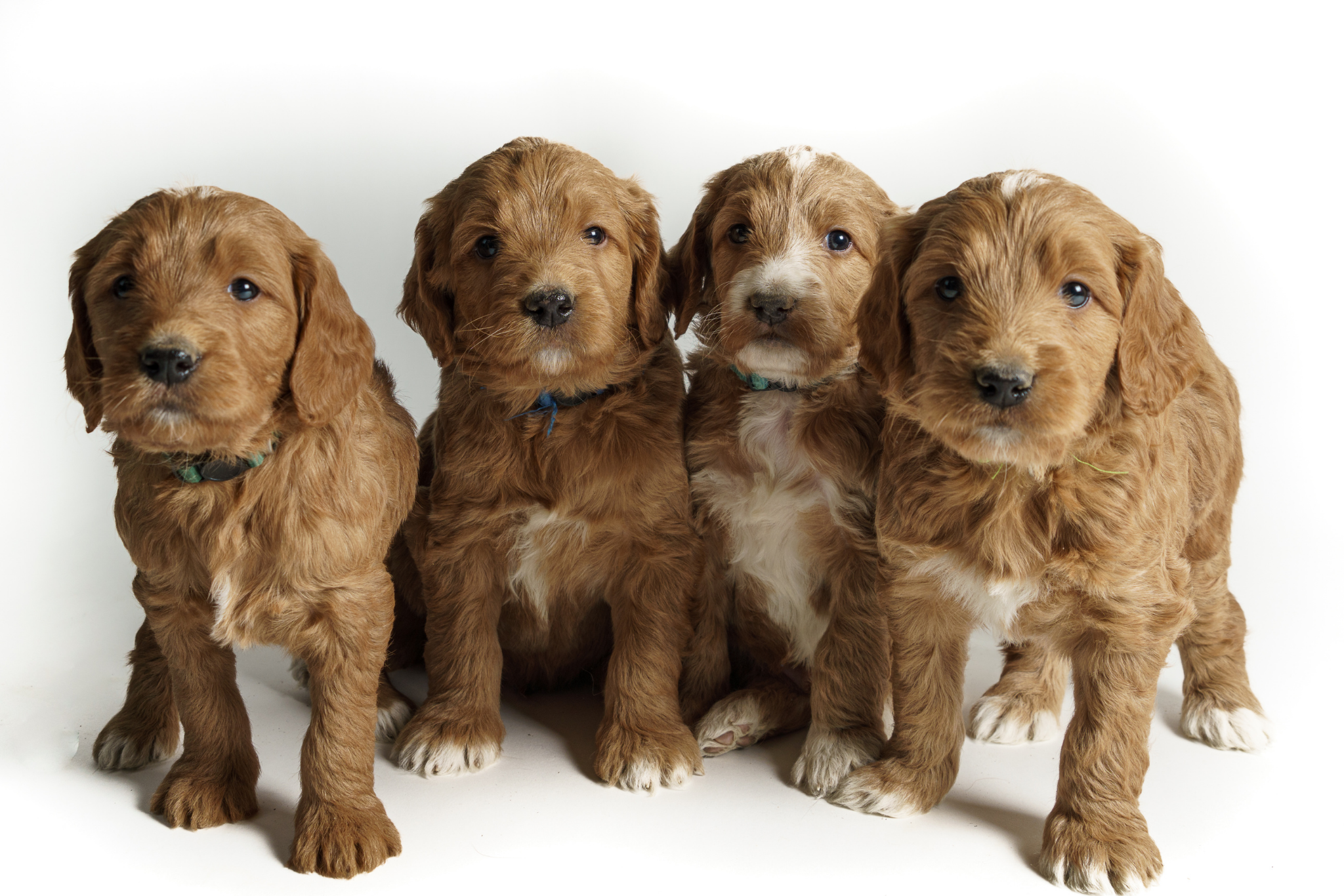
You’re scrolling through pictures of Goldendoodle puppies and see one mother snuggled with a dozen tiny pups, but the breeder you just called only has a litter of four. What gives? While it’s easy to assume something is wrong, the answer isn’t a red flag—it’s simple biology. Goldendoodle litter sizes vary dramatically, and the reason often comes down to one key factor.
The single most significant element in predicting your dog’s litter size is the size of the mother dog. Think of it like this: a larger mother simply has more ‘room’ to safely carry and nourish a larger number of puppies. Reputable breeders and veterinarians agree that the mother’s physical capacity is the primary constraint on litter count, which explains the wide range you see from one litter to the next.
This difference becomes crystal clear when comparing the different types of Goldendoodles. A 60-pound Standard Goldendoodle, who gets her size from a Standard Poodle parent (where the standard poodle litter size average is also quite large), can comfortably have a litter of 8 to 12 puppies. In contrast, when you ask how many puppies can a mini goldendoodle have, the answer is naturally smaller. A 25-pound Mini, whose parent is a Miniature Poodle, will typically have a litter of around three to six healthy puppies. It’s a simple matter of space.
So, where does the father dog fit into all this? While the father’s genetics are crucial for determining the puppies’ eventual size, health, and temperament, his own size has very little impact on the number of puppies in a litter. That responsibility falls almost entirely to the mother, whose body and breed background set the stage for how many new furry family members she can bring into the world.
What Do “F1” and “F1b” Mean for Litter Size?
As you browse breeder websites, you’ll inevitably run into terms like “F1” and “F1b.” These labels sound technical, but they are just a simple shorthand to describe a puppy’s parents and generation. More importantly, this genetic background can sometimes give us clues about the potential size of the litter.
To start, let’s decode those labels. It’s much simpler than it looks:
- F1 Goldendoodle: This is a “first-generation” puppy. The parents are a purebred Golden Retriever and a purebred Poodle.
- F1b Goldendoodle: The “b” stands for “backcross.” This means an F1 Goldendoodle was bred back to a purebred Poodle to increase the chances of a low-shedding coat.
So, how does this affect the number of F1 vs F1b Goldendoodle puppies? First-generation (F1) dogs often benefit from something called “hybrid vigor.” Think of it as a natural boost that can come from mixing two distinct and healthy gene pools. This genetic advantage doesn’t guarantee a huge litter, but it can contribute to the robust health of the mother and puppies, sometimes leading to litters on the larger side of the average.
When it comes to an F1b litter, the genetic equation shifts slightly. Because an F1b puppy has a Goldendoodle parent and a Poodle parent, its traits start to lean more toward the Poodle side. This can apply to litter size, too. The standard Poodle litter size average is typically between five and eight puppies, which aligns closely with the overall Goldendoodle average. Therefore, an F1b litter size is often solid and healthy, falling right within that expected range.
Why a Mother Dog’s Age and Health Are Critical for Litter Size
While genetics offers a glimpse into what’s possible, the mother dog’s individual condition plays an even more direct role in the health and size of her litter. Just like with people, a dog’s age and life stage have a tremendous impact on her body. For this reason, a first time Goldendoodle mother litter is often smaller than her subsequent ones. Her body is still adjusting to the demands of pregnancy, and a smaller litter of three to five puppies is completely normal and often healthier for her first experience. It’s a sign of a natural, healthy progression, not a problem.
So, when is a mother dog most likely to have a larger litter? Most breeders and veterinarians agree that a dog’s prime breeding years are between the ages of two and five. During this window, she is fully mature, strong, and at her physical peak to handle the rigors of carrying and nursing a larger litter. As she gets older, you might wonder, do older dogs have smaller litters? Generally, yes. After about age six, litter sizes often begin to decrease again as her body naturally prepares for retirement from breeding.
Of course, age is only one piece of the health puzzle. The mother’s overall condition before and during pregnancy is perhaps the single most important factor. A dog that is at a healthy weight, fed a high-quality diet rich in nutrients, and kept in a low-stress environment is simply better equipped to produce and care for her puppies. Ultimately, a healthy mother is far more important than a record-breaking litter size. A small litter from a happy, well-cared-for mother is always preferable to a large litter from a dog in poor condition.
A Breeder’s Role: It’s Not Just About Numbers, It’s About Health
Seeing a breeder’s commitment to the mother dog’s health is one of the clearest signs you’re working with someone reputable. For them, preparing for a Goldendoodle whelping (giving birth) begins long before the dogs even meet. A responsible breeder’s primary goal isn’t to produce the largest litter possible, but to ensure the mother is in peak condition to have a healthy, safe pregnancy. They understand that the dam’s health directly influences the puppy count, and more importantly, the vitality of each pup. This philosophy shift—from quantity to quality—is the very foundation of ethical breeding.
This dedication to health extends to proactive, preventative care. The best breeders invest in extensive health screenings for both parent dogs before a breeding is ever planned. This involves testing for genetic conditions common in Golden Retrievers and Poodles, such as hip dysplasia, eye disorders, and heart issues. By ensuring both parents are free of these hereditary problems, the breeder gives the future puppies the best possible genetic start in life. It’s an expensive and time-consuming process, but it’s a non-negotiable part of responsible breeding practices.
Ultimately, a breeder’s focus on the mother’s well-being is a huge “green flag” for any prospective owner. If a breeder proudly tells you their dog had a smaller-than-average litter but that the mother and puppies are thriving, you should be reassured, not concerned. It shows they prioritize the dog’s welfare over profit. After all this careful planning and health screening, the next step is confirming the pregnancy and getting an idea of just how many puppies are on the way.
Counting Puppies Before They Arrive: A Guide to Ultrasounds and X-Rays
Once a breeder suspects their Goldendoodle is expecting, the natural next question is, “How many?!” Veterinarians have two key tools they use during the nine-week pregnancy to monitor the puppies: an ultrasound and an X-ray. Each one serves a very different purpose at a different time, creating a clear timeline for predicting the litter size.
The first major milestone is the ultrasound, typically performed about four weeks into the pregnancy. The primary goal here isn’t to count puppies, but to confirm the pregnancy is viable. The vet looks for tiny, flickering heartbeats and gestational sacs. Trying to use an ultrasound to count puppies this early is notoriously inaccurate; the tiny, squirming pups can easily hide behind one another. A breeder might get an estimate like “at least five,” but this is never a final number.
For a more accurate headcount, breeders rely on an X-ray. This is done much later in the pregnancy, usually around day 55 (just one week before the puppies are due). By this point, the puppies’ tiny skeletons have calcified enough to show up clearly on the film. This allows the vet to count each individual skull and spine, providing a highly reliable number. Knowing the final count is crucial, as it helps the breeder prepare for the birth and ensure every single puppy is safely delivered.
What’s a “Large” or “Small” Goldendoodle Litter? (And When to Worry)
After seeing that final X-ray count, it’s natural to wonder where the number falls on the spectrum. For Goldendoodles, a litter of ten or more puppies is generally considered large, while a litter of four or fewer is seen as small. With the average hovering around eight, most litters land somewhere in between. However, these labels don’t automatically signal “good” or “bad.” The context behind the count is far more important.
A small number, for instance, is rarely a cause for alarm on its own. The most common reason for a small litter is simply the size of the mother; a 25-pound Miniature Goldendoodle has less room than a 60-pound Standard, so her litters of three to five puppies are perfectly normal and healthy. A mother dog’s age and whether it’s her first litter are also major factors. As long as the puppies and mom are thriving, a small number is not a red flag.
Conversely, a huge litter of twelve puppies isn’t necessarily better. Large litters can be physically demanding on the mother and sometimes require the breeder to supplement with bottle-feeding to ensure every puppy gets enough nutrition. The real indicator of quality isn’t the size of the litter, but the breeder’s response to it. A responsible breeder can explain the factors that led to the litter size and will have a clear, dedicated plan to care for every puppy.
Goldendoodle vs. Labradoodle: A Quick Litter Size Comparison
If you’re exploring different “doodle” breeds, you might be curious how this all stacks up in a Goldendoodle vs. Labradoodle litter comparison. The good news is that the information is almost perfectly interchangeable. Labradoodles, the popular mix of a Labrador Retriever and a Poodle, follow the same general rules. The average number of puppies for a Labradoodle is also right around eight, with a similar range from small litters of three to large ones of twelve.
The reason for this striking similarity comes down to a shared parent: the Poodle. Because both mixes depend on the Poodle for their genetics (and often, their size category), the same factors that influence a Goldendoodle litter also apply to a Labradoodle litter. The mother’s size, her overall health and age, and even the generation of the puppies (F1, F1b, etc.) will impact the final count in the exact same way.
What This All Means For You: Key Questions to Ask Your Breeder
Understanding the story behind a litter’s size is more valuable than knowing a single average number. Knowing how a mother’s size, health, and generation (F1 or F1b) all play a crucial role makes you an informed, prepared partner in the process of finding your new family member.
With this knowledge, you’re ready to have a confident and productive conversation with any breeder. Use the following questions as a guide to learn more about their program and find the right fit. This will show your commitment to finding a healthy, well-cared-for puppy.
Here are a few great questions to ask a breeder:
- How old is the mother dog, and is this her first litter?
- What are the approximate sizes and weights of both the mother and father?
- Are these puppies F1 or F1b Goldendoodles?
- How did you prepare for the whelping to ensure the mother’s health?
- Can you tell me more about the puppies’ and mother’s health since the birth?
Remember, the goal isn’t just about finding a responsible breeder—it’s about building a relationship with one. The perfect litter isn’t defined by its size but by its health and the care it received. By focusing on quality over quantity, you’re not just choosing a puppy; you’re starting your journey together on the strongest, healthiest foundation possible.


