 Skip to content

You’ve seen them everywhere: the adorable, real-life teddy bears trotting happily beside their owners. With their fluffy coats and friendly faces, Goldendoodles have a charm that’s hard to resist. But what really happens when that tiny, eight-pound ball of fur grows up? The journey from a clumsy puppy to a confident adult involves predictable stages, from a needy infant phase to a rebellious teenage period. This guide offers a realistic look at how the Poodle and Golden Retriever mix personality—a unique blend of cleverness and goofy affection—shines through at each phase, turning overwhelming challenges into manageable moments.
What Does F1 vs. F1B Mean? A Simple Guide to Your Puppy’s Background
As you start looking for a Goldendoodle puppy, you’ll quickly run into confusing codes like “F1” or “F1B” from breeders. While they sound technical, these labels are just a simple way to describe the puppy’s parents and predict its coat type. Knowing what they mean helps you choose the right dog for your lifestyle, especially if shedding is a concern.
Think of it like a simple recipe. The first generation, or F1, is the original mix of a purebred Golden Retriever and a purebred Poodle. Because their genetics are a 50/50 split, their appearance can be a surprise package. To get a more predictable, low-shedding coat, breeders often perform a backcross. This involves breeding an F1 Goldendoodle back to a purebred Poodle, creating an F1B puppy.
So, what does this mean for your allergies and your vacuum cleaner? While no dog is 100% hypoallergenic, the generation makes a big difference in how much they shed.
- F1 Goldendoodle: 50% Golden Retriever + 50% Poodle. Can have wavy or straight coats and may shed lightly.
- F1B Goldendoodle: 75% Poodle + 25% Golden Retriever. Often have curlier coats and are usually the best choice for families wanting a very low-shedding dog.
Surviving the First Month: A Simple Plan for Potty and Crate Training
Bringing that tiny ball of fluff home is exciting, but the first question on everyone’s mind is always potty training. The key to minimizing accidents is a simple, time-based schedule. A good rule of thumb is that puppies can “hold it” for one hour per month of age. For your eight-week-old puppy, this means a trip outside every two hours—and immediately after waking up, playing, and eating. Sticking to this schedule is the fastest way to build a good habit.
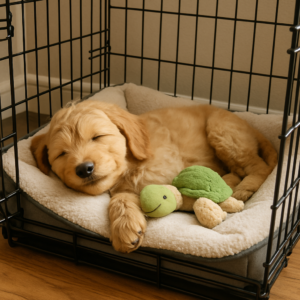
To make house-training even easier, many owners find success with crate training. The secret is to introduce the crate as your puppy’s very own safe, cozy bedroom, not as a jail. Make it comfortable with a soft bed and a special toy, and never use it as punishment. This transforms it into a den where they feel secure and are naturally less likely to have an accident. An open crate gives them a reliable retreat when they need a nap or some quiet time.
Those first few nights can be tough as your puppy adjusts to being alone. If they cry, try placing the crate in your bedroom where they can see and smell you. Your presence is often all the reassurance they need to settle down. As you navigate these early weeks, you’ll also notice your puppy exploring the world with their mouth, which often leads to another challenge: nipping and biting.
How to Stop Your Goldendoodle Puppy from Biting Everything (Including You)
If it feels like your new puppy is a tiny, fluffy piranha, you’re not alone. This constant nipping isn’t aggression; it’s how puppies explore the world. Just as babies reach out to touch everything, Goldendoodle puppies use their mouths to learn about textures and test their strength. Your goal isn’t to punish the biting, but to teach them gentleness and what’s okay to chew on.
The simplest method to stop puppy biting is redirection. The moment you feel those sharp little teeth on your skin, let out a firm but not frightening “Ouch!” and pull your hand away. Immediately offer them an appropriate chew toy. This quick swap sends a clear message: “Hands are not for biting, but this toy is!” Being consistent with this rule helps your smart puppy understand the boundaries of playtime.
This lesson is also time-sensitive. The most critical period for a puppy to learn a “soft mouth” is before 16 weeks of age. This brief socialization window is when their brains are uniquely wired to learn social rules. It’s the perfect opportunity to teach them gentle play, which often lines up with their first vet appointments. Be sure to discuss your puppy’s vaccination schedule with your vet so they can safely meet other dogs and continue learning these important manners.
How Big Will My Goldendoodle Get? A Month-by-Month Growth Guide
One of the biggest questions new owners have is just how big that tiny ball of fluff will become. Since Goldendoodles are a mix, their final size depends on their parents, but they generally fall into three categories. While a detailed growth chart can help you track their progress, here are the typical ranges you can expect:
- Mini Goldendoodle: 15-30 pounds
- Medium Goldendoodle: 30-45 pounds
- Standard Goldendoodle: 45-90+ pounds
For a more personal estimate, a great rule of thumb is to take your puppy’s weight at 16 weeks (four months) and double it. This simple calculation often gives a surprisingly accurate guess of their final adult weight. So, when do Goldendoodles stop growing? Smaller dogs usually reach their adult weight by 9-11 months, while larger Standards can continue filling out until they are 18 months old.
Along with this rapid growth comes another major transformation: their coat. The soft, wispy puppy fur will begin to change between six and twelve months of age. As the new hair grows in thicker, denser, and often wavier or curlier, this adult coat is what requires regular brushing to prevent tangles. Its arrival is a sure sign your dog is leaving puppyhood behind.
Help! My Perfect Puppy Forgot Everything: Navigating the “Teenage” Phase
Just when you’ve celebrated a week of perfect behavior, it can feel like your well-trained puppy has decided to forget everything. They might ignore commands they once knew flawlessly, pull on the leash again, or act like they’ve never heard the word “come.” This isn’t a training failure; it’s the completely normal adolescent stage. Typically happening between six and eighteen months, this “teenage” phase is a natural part of their development as they test boundaries and assert independence.
This sudden bout of selective hearing is often fueled by their clever and curious mix of Poodle and Golden Retriever personalities. Their intelligence means they are not just forgetting rules—they are actively exploring what happens when they break them. You might see a frustrating return of behaviors you thought were long gone, like chewing and biting. Remember, this phase is driven by hormones and brain development, not a sign of a “bad dog.”
The solution is not more discipline, but more patience and a return to basics. Keep training sessions short, fun, and highly rewarding, using high-value treats to remind them that listening is worthwhile. Reinforce foundational commands like ‘sit’ and ‘stay’ just as you did in their first few weeks. By staying consistent and positive, you are building the framework for the loyal, well-adjusted adult companion your Goldendoodle is about to become.

What Does an Adult Goldendoodle Need? Your Daily Exercise and Mental Health Plan
Once they’ve settled into their adult years, how much exercise do they need? For most adult Goldendoodles, 45 to 60 minutes of solid physical activity each day is a great target. This doesn’t have to be a marathon—a brisk walk, a lively game of fetch, or a romp at the dog park will do. Keeping them physically active is fundamental to managing their energetic nature and maintaining a healthy weight.
A long walk, however, only solves half the equation. Thanks to their sharp Poodle intellect, a bored Goldendoodle is often a mischievous one. If your dog gets plenty of exercise but is still chewing on the remote, their brain is likely asking for a workout. This need for mental stimulation is the secret to a truly calm and content companion.
Giving their brain a job is easier than you think. Instead of just pouring food into a bowl, make them work for it using puzzle toys or a “snuffle mat” where they have to hunt for their kibble. Even a simple game of “find it,” where you hide a treat and encourage them to use their nose, can tire them out more than an extra walk. This daily mental engagement is key to their happiness, but so is managing their famous coat.
The Truth About Goldendoodle Grooming: How to Prevent Painful Matting at Home
That beautiful, low-shedding coat comes with a serious responsibility. As your puppy’s soft fur transitions into the denser adult coat, the risk of matting skyrockets. Matting happens when loose hairs tangle into tight knots close to the skin. Far from being a cosmetic issue, these mats pull painfully on the skin, restrict airflow, and can hide infections or parasites. For a Goldendoodle, preventing matting is a fundamental part of their healthcare.
Successful at-home grooming involves just two essential tools and ten minutes a day. First, use a slicker brush to work through the outer coat in small sections. Then, follow up with a sturdy metal comb (often called a greyhound comb) to check your work. The goal is to glide the comb from the root of the hair to the tip. If it gets stuck, you’ve found a tangle that needs to be gently worked out. This “brush and check” method is the only way to ensure you’re reaching the hair closest to the skin.
While daily brushing is your first line of defense, it doesn’t replace professional grooming. A full haircut from a groomer every 6-8 weeks is a non-negotiable part of Goldendoodle ownership. They have the specialized tools and training to safely trim sensitive areas and maintain a healthy, manageable coat length. Think of your groomer as a partner in your dog’s wellness.
Keeping Your Goldendoodle Healthy for Life: Common Issues and Average Lifespan
Just as grooming is essential, a few proactive habits are vital for your dog’s long-term health. Due to their genetic heritage, there are some common health issues to be aware of, like hip dysplasia, a painful joint condition. A major factor you can control is their weight. Keeping them lean puts far less stress on their joints and is one of the most effective ways to support their mobility for years to come.
Those adorable, floppy ears also need regular attention. Their ear shape can trap moisture, creating the perfect environment for painful infections. Make it a habit to check their ears weekly for any redness or unusual odor. After a bath or a swim, a quick, gentle wipe with a vet-approved solution helps keep them dry and healthy.
By partnering with your vet and staying on top of these simple preventative measures, you’re setting your companion up for a long, comfortable life. So, what is the average Goldendoodle lifespan? With attentive care, these cheerful dogs typically live between 10 and 15 years, offering more than a decade of joyful companionship.
Your Lifelong Journey with a Goldendoodle: The Best is Yet to Come
The journey from a clumsy puppy to a confident adult is now clearer. The challenges—from nipping and house-training to sudden adolescent deafness—are not failures but normal signposts on their path to adulthood. Every moment of patience is an investment in the incredible dog you are raising. The reward is an unbreakable bond that begins with that first pounce and only grows richer through the years.


