 Skip to content
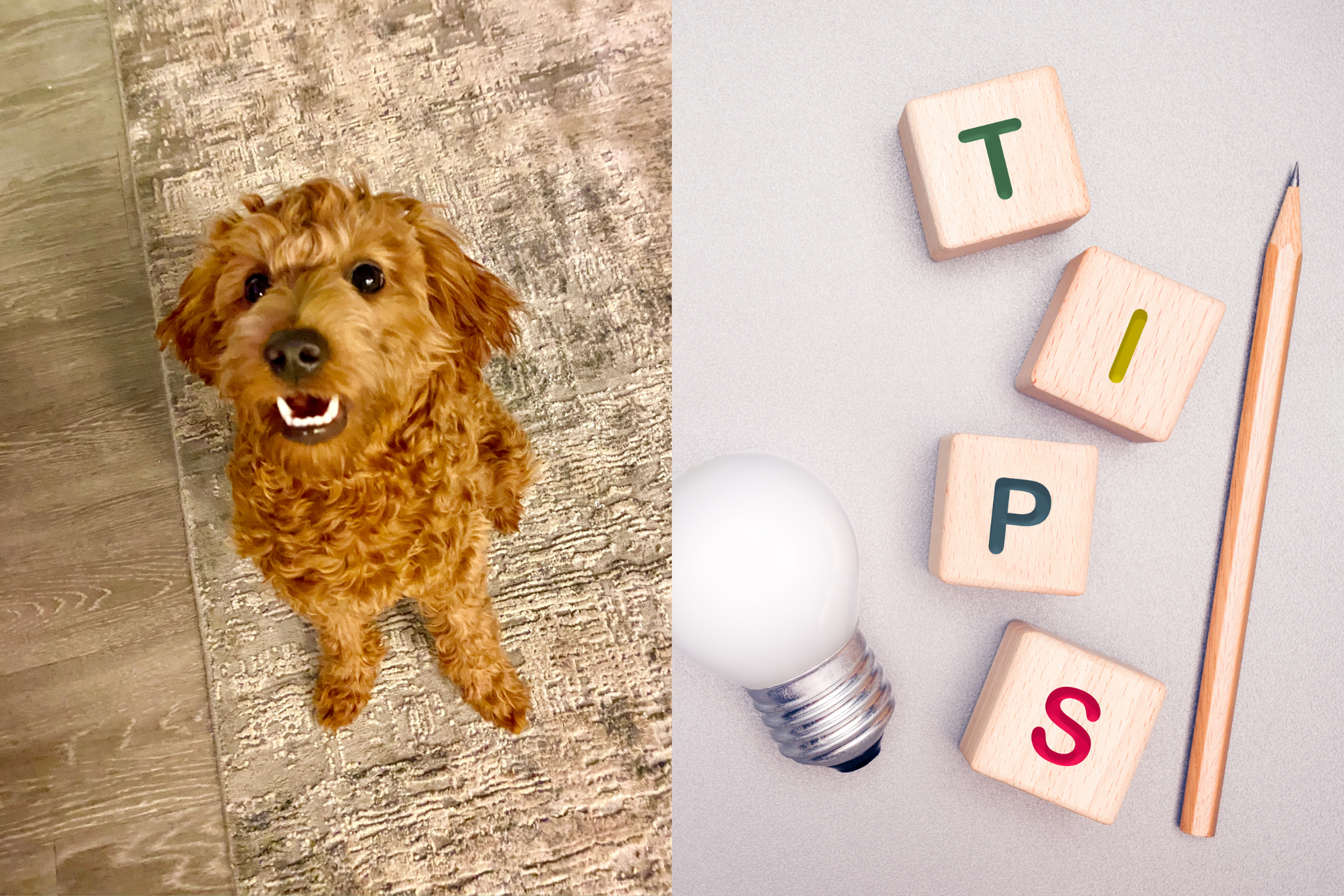
You’ve seen the adorable pictures on social media: a fluffy Goldendoodle posing patiently for the camera. Then you read a forum post from a frantic owner whose Doodle just ate their favorite pair of shoes. What’s the real story behind the fluff?
If you’re asking, “are Goldendoodles hard to train?”, the answer is more interesting than a simple yes or no. Their famous intelligence is both their greatest strength and your biggest challenge. They can learn a new command in an afternoon, but they’re also smart enough to invent their own fun if they get bored—and that’s where the trouble often starts.
Training success often has less to do with the dog and more to do with your approach. A Goldendoodle puppy thrives on clear guidance and mental engagement, not just repetitive drills. For many first-time Goldendoodle owners, understanding this unique need is the most important step toward building a great relationship.
This guide will demystify the Goldendoodle brain, provide simple, actionable steps for common challenges like nipping and jumping, and show you how consistency is the key to raising the happy, well-behaved companion you’ve been dreaming of.
The Goldendoodle Brain: Why “Smart” Doesn’t Always Mean “Easy”
To understand how to train a Goldendoodle, you first have to understand what’s going on inside that fluffy head. Think of their personality as a recipe with two powerful ingredients. From the Poodle side, they inherit a remarkable intelligence, which means they can learn new commands incredibly fast. From the Golden Retriever, they get a deep-seated desire to please and a friendly, social nature. This combination of Goldendoodle intelligence and temperament creates a dog that is both a quick study and deeply devoted to its people.
A brilliant mind that isn’t given a task will often invent its own—and you might not like the jobs it comes up with. Many owners wonder, “Why is my Goldendoodle so stubborn?” but what they’re often seeing isn’t stubbornness. It’s boredom. A Goldendoodle who isn’t mentally challenged is like a gifted child left alone in a room with a box of crayons; they’re going to find a wall to draw on. For your dog, this “drawing on the wall” might look like shredding pillows, barking at every sound, or learning how to open the pantry door.
This is why managing Goldendoodle behavior isn’t about just correcting bad habits, but about preventing them by giving their busy brain a job to do. They thrive on engagement. Short, fun training sessions, puzzle toys that make them think for their treats, or even simple games of hide-and-seek can satisfy their need for mental work. By channeling their intelligence proactively, you prevent boredom from taking root and turning into destructive or frustrating habits. This starts with knowing exactly when to begin.
What Age to Start Training a Goldendoodle for the Best Results
With a brain that’s always working, when should you start training your Goldendoodle? The answer is simple: the day you bring them home, typically around 8 weeks old. This doesn’t mean you should immediately start drilling “sit” and “stay.” For a young puppy, “training” is less about formal commands and more about establishing predictable, gentle routines. This early phase is your chance to build a foundation of trust and set clear expectations for life in your home.
Your initial goldendoodle puppy training schedule should focus on the absolute basics. This means establishing a consistent potty routine, making their crate a safe and happy den, and getting them comfortable with their name and a collar. Every positive interaction is a form of training, teaching your puppy that you are a source of safety and fun. For any first time goldendoodle owner, focusing on these simple patterns is far more important than teaching tricks. It’s about teaching them how to live successfully in a human world.
Beyond these routines, you have a brief, golden opportunity that most experts call the “socialization window.” From about 3 to 16 weeks of age, your puppy’s brain is like a sponge, soaking up information about what is safe and what is scary. Gently exposing them to a wide variety of new sights, sounds, and friendly people during this time is the single most effective way to prevent fear and anxiety later in life. It’s also when you’ll first encounter classic puppy behaviors, like using their teeth to explore everything—including you.
A Simple Fix for Goldendoodle Puppy Biting and Nipping
If you’ve spent any time with a Goldendoodle puppy, you’ve probably felt their needle-sharp teeth on your hands, ankles, or pant legs. This is one of the most frequent puppy challenges, but it’s not aggression. It’s a behavior called “mouthiness.” Just as human toddlers explore the world by touching everything, puppies explore by putting everything in their mouths. Your job isn’t to punish them for this instinct, but to teach them what is and isn’t okay to chew on.
The most effective fix for puppy nipping is a simple, two-step technique called redirection. The moment you feel their teeth on your skin, make a short, sharp sound like “Ouch!”—just enough to startle them into pausing. Immediately pull your hand away and offer them an appropriate chew toy instead. When they take the toy, praise them calmly. This simple sequence is one of the best Goldendoodle puppy biting solutions because it doesn’t just say “No”; it clearly shows them, “Don’t chew this, chew this instead.”
By consistently applying this method, you teach your smart puppy a valuable lesson: biting people stops the fun, but chewing on toys earns them praise and continued playtime. This process takes patience, and every family member needs to be on board. With repetition, your little land-shark will quickly learn how to interact gently, strengthening your bond and making those puppy cuddles much more enjoyable.
How to Potty Train Your Goldendoodle (and How Long It Really Takes)
When it comes to house training a puppy, the first question on every owner’s mind is, “How long will this take?” While your intelligent Goldendoodle might grasp the basic concept in a few weeks, achieving full, reliable bladder control takes time. For most puppies, you can expect occasional accidents for the first 4 to 6 months. Patience and consistency are your best tools for success, not punishment.
The secret to minimizing accidents lies in a predictable routine. Instead of waiting for your puppy to signal they need to go, take them out proactively. A simple but effective goldendoodle puppy training schedule prevents most issues before they start. Aim to take your puppy out at these key moments:
- First thing in the morning
- Within 15 minutes after every meal
- Immediately after waking up from a nap
- Right before bedtime
Even with a perfect schedule, accidents will happen. How you clean them up is critical. Do not use regular household soap or carpet cleaner. While it might look clean to you, leftover scent particles that only your dog can smell will act like a beacon, telling them, “This is an approved potty spot!” You must use an enzymatic cleaner, available at any pet store. This special type of cleaner contains enzymes that actually break down and eliminate the proteins in urine, completely removing the scent cue and preventing repeat offenses in the same spot.
The Secret to Stopping a Goldendoodle from Jumping on People
One of their most notorious habits is greeting everyone with an enthusiastic, two-pawed launch. While it comes from a good place—pure excitement and a desire to say hello—it can be frustrating for owners and intimidating for guests. Your dog jumps because it works. It instantly gets them a reaction, whether it’s a pat on the head or a frustrated “Down!” To your dog, any attention is good attention.
To stop a goldendoodle from jumping on people, teach them that four paws on the floor is what earns them affection. When your Doodle jumps, immediately turn your back, cross your arms, and look away. Give them zero attention—no words, no eye contact, no pushing. The moment they place all four paws back on the ground, turn around and reward them with calm praise and petting. This simple form of positive reinforcement for goldendoodles quickly teaches them the new equation: jumping makes people go away, but sitting politely makes them come back.
This training only succeeds if everyone in the house (and every visitor) is on the same page. Before a friend comes over, give them a quick instruction: “We’re teaching him not to jump. If he rushes you, could you just turn your back until he settles? Then you can give him all the love you want!” By managing these interactions, you create a consistent message that helps your smart pup learn faster. This same principle of creating a calm, predictable environment is essential when introducing your dog to their own special space, like a crate.
Crate Training a Goldendoodle: From “Jail” to “Safe Den”
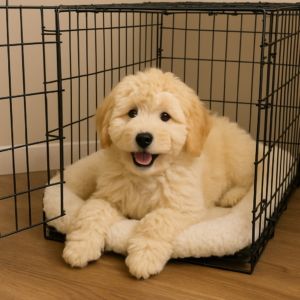
A calm, predictable environment is why crate training can be a lifesaver. For many new owners, the thought of putting their adorable puppy in a “cage” feels cruel, but dogs see a properly introduced crate as their personal den—a safe, quiet space where they can retreat and relax. Reframe it in your mind first: it’s not a jail cell; it’s your dog’s private bedroom. Knowing how to crate train a goldendoodle correctly from day one turns the crate into a powerful tool for house-training and peace of mind.
Making the crate a happy place is all about building a positive association. Start by placing a comfortable bed and a special, crate-only toy inside. Leave the door open and casually toss high-value treats in for your puppy to discover. Begin feeding them their meals inside the crate, still with the door wide open. Once they willingly go inside, you can start closing the door for just a few seconds at a time, immediately rewarding them with praise when you open it. This gradual process teaches them that the crate is a wonderful place where good things happen.
A great rule of thumb for your goldendoodle puppy training schedule is their age in months plus one hour. For example, a three-month-old puppy can typically handle up to four hours. This guideline in puppy crate training helps prevent accidents and ensures the crate remains a positive space, not a source of distress.
The Two Master Keys to Goldendoodle Training: Consistency and Enrichment
Two keys unlock almost all goldendoodle training challenges: consistency and enrichment. The first, and most important, is Consistency. Because your Doodle is so intelligent, they are experts at finding loopholes. If one person in the house lets them jump up for a greeting, but another doesn’t, the dog learns that “it’s always worth a try!” Every single family member must be on the same page with the rules. For a smart dog, consistency isn’t just helpful; it’s the entire foundation of their training.
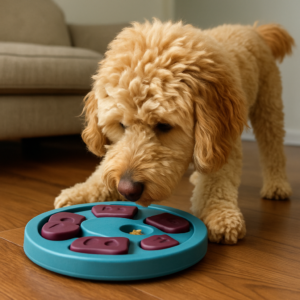
The second key is Enrichment. This is just a fancy word for giving your dog’s busy brain a job to do. A bored Goldendoodle is like a brilliant toddler with a new set of crayons but no paper—they will find a wall to draw on. Destructive chewing, excessive barking, and digging are often not signs of a “bad dog,” but simply a brilliant mind desperate for stimulation. Providing daily enrichment is one of the most effective positive reinforcement techniques for goldendoodles because it channels their energy into appropriate activities, preventing problem behaviors before they even start.
Enrichment doesn’t have to be expensive or time-consuming. You can tire out your dog’s brain in just a few minutes a day, which is crucial for successful goldendoodle puppy training.
- 5-Minute Enrichment Ideas:
- Use a puzzle feeder for meals instead of a regular bowl.
- Hide 3-4 treats around the room and teach the “Find it!” game.
- Practice a new trick for five minutes, like “shake” or “spin.”
- Let them shred an empty cardboard box or paper towel roll (with supervision).
- Go on a “sniffari,” a short walk where you let them lead the way and sniff absolutely everything they want. This mental workout is often more tiring than a brisk walk.
Putting these two keys together—unbreakable consistency from you and daily mental jobs for them—creates a well-behaved companion. This combination is especially critical when you leave the house and clip on the leash, where a bored mind and inconsistent rules can create a frustrating pulling experience.
How to Leash Train a Hyper Goldendoodle Who Pulls
That feeling of your arm being pulled from its socket is one of the most familiar training challenges. You’re ready for a relaxing stroll, but your dog is trying to launch themselves toward every squirrel, person, and interesting smell. This isn’t defiance; it’s their friendly, curious nature overflowing. Your goal isn’t to punish the pulling, but to teach them that a loose leash is the magic key that makes the walk continue.
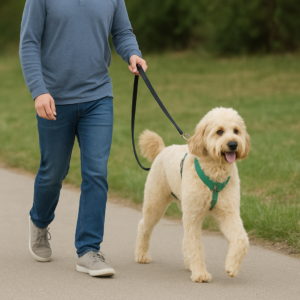
One of the best positive reinforcement methods for this is a simple “Stop and Go” game. The moment you feel the leash tighten, just stop walking. Don’t yank the leash or scold your dog; simply become a statue. The instant the leash goes slack—either because they turn to look at you or take a step back—happily say “Yes!” and immediately start walking again. Your Doodle’s smart brain quickly makes the connection: “Pulling makes the fun stop, but a loose leash makes us go!”
To make leash training a hyper goldendoodle much easier, consider switching to a front-clip harness. Unlike a collar or a back-clip harness that can encourage pulling (like a sled dog), a front-clip harness attaches the leash to a ring on your dog’s chest. When they surge forward, the harness gently redirects their momentum, turning them back toward you. This tool doesn’t cause pain; it simply makes pulling less effective and helps you both enjoy your walks while they learn.
Goldendoodle vs. Labradoodle vs. F1/F1B: Does It Affect Trainability?
When comparing goldendoodle vs labradoodle trainability, you’re really looking at the subtle differences between their retriever parents. Golden Retrievers tend to be exceptionally eager to please and sensitive, while Labrador Retrievers can bring a bit more boundless energy and goofy drive to the mix. Both are famously intelligent and friendly, so any difference in day-to-day training is usually minor. You’re just as likely to find a calm Labradoodle as you are to find a high-energy Goldendoodle.
You might also hear breeders use terms like “F1” and “F1B.” This is just a simple way to describe the dog’s generation. An F1 is a direct 50/50 mix of a Poodle and a Retriever. An F1B is a Goldendoodle that has been bred back to a Poodle, making it roughly 75% Poodle. While the higher Poodle percentage can amplify traits like intelligence and sensitivity, analyzing F1 vs F1B goldendoodle behavior isn’t a perfect predictor of how easy your specific dog will be to train.
These labels are far less important than two key factors: the dog’s individual personality and your commitment to training. A mellow F1 puppy will be easier to handle than a high-strung F1B, and vice versa. Instead of getting bogged down by the specific mix, focus on the unique goldendoodle temperament of the dog in front of you. Consistent, positive training is the secret ingredient that works for every single type.
Common Goldendoodle Behavior Problems and What They Mean
When you’re dealing with a chewed-up shoe or a dog who won’t stop barking at squirrels, it’s easy to get frustrated. These behaviors can make you feel like you have a uniquely difficult dog. But what looks like misbehavior is often your dog’s way of communicating an unmet need. Stop seeing these issues as acts of defiance and start translating them into a simple request.
That Goldendoodle surfing your kitchen counters isn’t trying to be bad; he’s using his Poodle intelligence and Retriever nose to solve a puzzle that has a delicious reward. The same goes for the one who un-stuffs your couch pillows. It’s easy to wonder, “why is my goldendoodle so stubborn?” but the reality is that a bored brain will always find a job to do. In these cases, the behavior is a clear sign your dog is craving more enrichment and mental exercise.
Instead of seeing these training issues as a reason for punishment, try seeing them as a clue. A dog that barks endlessly at the window isn’t being a nuisance on purpose; he’s taken on the job of “Neighborhood Watch” because he needs an outlet for his energy and alertness. Your goal isn’t to punish the barking, but to provide a better, more appropriate job for him to do, like working on a puzzle toy or practicing a new trick with you.
Shifting from “punishing bad behavior” to “fulfilling an unmet need” is the most powerful tool in your training toolbox. When you learn to ask “What is my dog trying to tell me?” instead of “How do I make him stop?”, you’re no longer just managing problems—you’re building a stronger, more cooperative relationship.
Your Blueprint for a Well-Behaved Goldendoodle
The question isn’t whether Goldendoodles are “hard to train,” but how to best direct their intelligence. Their bright minds and friendly hearts aren’t a challenge to be managed, but an opportunity to be channeled with clear, positive guidance.
For any first-time Goldendoodle owner, success comes down to three simple pillars. Keep these core goldendoodle training tips on your fridge or phone as your guide:
- Give Their Brain a Job: Acknowledge their intelligence with puzzle toys and short, fun training sessions. A busy mind stays out of trouble.
- Keep It Consistent: Ensure everyone in your home uses the same rules and commands. Predictability is your puppy’s best friend.
- Reward the Good: Focus on teaching what you want them to do. Lavish praise on calm behavior, sitting politely, and chewing the right things.
You’re not just getting a dog; you’re building a partnership. With these tools, you are fully equipped for the rewarding journey of raising a Goldendoodle who is a happy, well-mannered joy to live with.


