 Skip to content
Congratulations on your new Goldendoodle puppy! You’re picturing friendly walks, cozy cuddles, and a loyal companion. But right now, you might be facing the reality of a tiny tornado with sharp teeth and endless energy.
If you feel overwhelmed, take a deep breath. Certified trainers agree that common puppy problems like chewing and potty accidents aren’t signs of a ‘bad dog.’ They’re normal behaviors from a puppy who hasn’t learned the rules of a human home. This guide will help you focus on the fundamentals: establishing a foolproof potty routine, managing nippy biting, and teaching your pup to love their crate.
With the right approach, you can navigate these early hurdles and turn that puppy chaos into the well-behaved best friend you’ve always wanted.
Why Your Mini Goldendoodle is So Smart (and Energetic)
Ever wonder where your Mini Goldendoodle gets that boundless energy and cleverness? It’s a direct inheritance from its parent breeds: the brilliant Poodle and the eager-to-please Golden Retriever. You’ve welcomed a furry little athlete with a super-computer for a brain into your home. This combination of high intelligence and a need for activity is a core part of the mini goldendoodle temperament and trainability.
Without a “job” to do, that big brain will find its own entertainment—and you might not like the results. This leads to behaviors like chewing furniture or nuisance barking. This isn’t your puppy being ‘bad’; it’s a smart dog telling you they’re bored. This is why providing mental stimulation, like puzzle toys or five-minute training games, is just as important as a daily walk. A tired dog is good, but a mentally tired dog is even better.
The great news is that this intelligence is your biggest training advantage. A smart dog learns faster, making your job as a trainer easier and more rewarding. The answer to are mini goldendoodles easy to train is less about the dog and more about you providing clear guidance. You have a star pupil on your hands, so let’s start with the first, most important lesson.
Your Step-by-Step Potty Training Schedule That Actually Works
The secret to how to potty train a mini goldendoodle puppy isn’t waiting for them to tell you; it’s creating a predictable routine. A young puppy can’t hold it for long, so your job is to provide frequent, consistent opportunities to succeed.
For a young puppy, this means taking them out more often than you think. A great starting point for a reliable puppy potty schedule is to take them out:
- First thing in the morning
- Immediately after every nap
- After every play session
- Within 15 minutes of eating or drinking
- Right before bedtime
To make trips outside more efficient, introduce a potty command. The moment your puppy starts to go, say a cue word like “Go Potty” in a calm voice. Once they finish, immediately reward them with enthusiastic praise and a small treat. Your smart Goldendoodle will quickly learn that this word means it’s time to do business, which is incredibly helpful on rainy days.
Accidents will happen—it’s a normal part of the process. Avoid punishment, which only teaches your puppy to fear you. Instead, clean up correctly. Standard household cleaners won’t work. You need an enzymatic cleaner from a pet store to completely break down the odor molecules your puppy can still smell. This prevents them from returning to the same spot again.
How to Make the Crate Your Puppy’s Favorite Room (Not a Punishment)
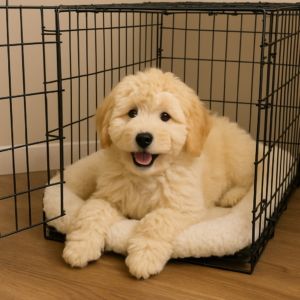
It’s time to transform the crate from a ‘cage’ into your puppy’s cozy den. Many owners feel guilty about using a crate, but when introduced correctly, it becomes a safe haven your dog loves. Think of it as their personal bedroom—a place to rest, feel secure, and decompress. This positive association is the secret to successful crate training.
Start by turning the crate into a fun game. Toss a few high-value treats (like tiny pieces of chicken) into the back of the crate while leaving the door wide open. Let your puppy explore and grab the treat without being forced inside. Repeat this several times over a few days. This uses positive reinforcement, teaching your puppy that great things happen near their crate.
Once your puppy happily enters the crate for treats, start feeding their meals inside, still with the door open. After a few days, try closing the door just while they are eating and opening it the second they finish. This begins your simple mini goldendoodle crate training schedule, gradually showing them that a closed door is temporary and not scary.
A puppy who loves their crate is far less likely to struggle with being left alone, making this one of the most effective solutions for mini goldendoodle separation anxiety. You’re not just managing their space; you’re building their confidence.
Nip It in the Bud: How to Stop Your Mini Goldendoodle from Biting
If your puppy’s tiny teeth feel like needles, you’re not alone. This constant puppy mouthing is how they explore the world and initiate play, not a sign of aggression. Your job isn’t to eliminate biting but to teach them that human skin is sensitive. This is the most important step to stop your mini goldendoodle from biting people long-term.
This is where you teach bite inhibition, or a ‘soft mouth’—the same lesson puppies learn from their yelping littermates. The moment you feel their teeth on your skin, let out a sharp, high-pitched ‘Ouch!’ and briefly pull your hand and all your attention away. The message is clear: when teeth touch people, all the fun stops.
After a brief pause, redirection is crucial. Your puppy has a natural urge to chew, so immediately offer an appropriate chew toy. This simple swap teaches a vital rule: ‘Hands are for licking, toys are for chewing.’
The Golden Window: What is Puppy Socialization and Why It Can’t Wait
Teaching a soft mouth helps your puppy interact safely with people, but what about the rest of the world? The answer to when to start training a goldendoodle puppy begins with socialization, a concept even more time-sensitive than ‘sit.’
Your puppy’s brain is a sponge between 8 and 16 weeks of age, a developmental ‘golden window’ for forming opinions about the world. Experiences during this brief period have a massive impact on whether they grow into a confident, relaxed adult or a fearful, reactive one. The window closes quickly, so this work cannot wait.
Good socialization isn’t about overwhelming your puppy at a busy dog park; it’s about engineering calm, happy, and brief introductions to new things. Here, positive reinforcement techniques shine: pair a scary-looking person or the rumble of a vacuum cleaner with a high-value treat. The goal is simple: create a positive association so your puppy learns, “New things predict good things!”
Focus on quality over quantity with this simple puppy socialization checklist. Let your puppy experience these things from a safe distance, rewarding them for calm behavior.
- People: Individuals wearing hats, sunglasses, or carrying bags.
- Surfaces: Walking on grass, pavement, a rug, and a slippery floor.
- Sounds: A doorbell, the vacuum cleaner, and distant traffic.
- Objects: A rolling suitcase, an opening umbrella, or a bicycle.
Your Training Starter Pack: The 3 Most Important First Commands
With socialization underway, you can build your communication toolkit. Instead of tackling a long basic obedience commands list, focus on three key skills first to build confidence. This is your essential starter pack for a well-behaved companion.
Start with ‘Sit,’ the easiest way to introduce training. Using lure training, hold one of the best training treats for doodles (like tiny bits of cheese) near your puppy’s nose. Slowly guide their head up and back; as their nose goes up, their bottom will naturally go down. The instant they sit, say an enthusiastic ‘Yes!’ and give them the treat.
Next is arguably the most important safety command: ‘Come.’ Your goal is to make this word sound like an exciting party invitation. Use a happy, high-pitched tone and reward them with an amazing treat or a favorite toy only when they come to you. This builds recall reliability. Never use ‘Come’ to call them for something they dislike, like a bath.
Finally, ‘Leave It’ is your emergency brake. It teaches your puppy to ignore dropped items, which is a lifesaver. Start by rewarding them for turning away from a less-exciting kibble on the floor to earn a better treat from your hand. Mastering this prevents dangerous scavenging and lays the groundwork for more advanced manners.
The Four-on-the-Floor Rule: How to Stop Your Goldendoodle From Jumping
Jumping is a common complaint, but pushing your dog down or saying ‘No!’ often makes it worse. To an excited Goldendoodle, any attention is a reward that reinforces the behavior. To solve the problem, teach them that jumping makes the fun stop, and keeping all four paws on the floor makes the good stuff happen. This is a core part of training with positive reinforcement.
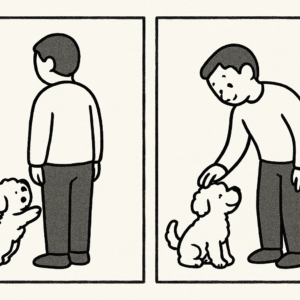
Here’s how to stop a goldendoodle from jumping: The moment their front paws leave the ground, immediately turn your back on them. Become as boring as a wall—no talking, touching, or eye contact. The instant all four paws are back on the floor, turn around and calmly reward them with praise or a small treat. This teaches a clear lesson: jumping gets me ignored, but staying down gets me attention.
Manage this during exciting moments, like when guests arrive. Keep your puppy on a short leash and instruct visitors to ignore them until they are calm. Once your dog is standing or sitting politely, your guest can offer a gentle pet. Practicing these polite greetings for dogs creates a reliable habit and prevents jumping from becoming a lifelong issue.
From Dragging to Strolling: Your Simple Guide to Loose-Leash Walking
Are walks more of a drag than a stroll? Your Goldendoodle isn’t being difficult; they’re just excited to explore and have learned that pulling gets them there faster. Learning how to leash train a miniature goldendoodle means flipping that script. The new rule for loose-leash walking is simple: a tight leash stops the walk, but a loose one continues the adventure.
Practice the ‘Be a Tree’ method. The instant you feel the leash go taut, stop walking. Plant your feet and stand still until your dog creates slack in the leash—even for a second. The moment they do, immediately start walking forward again. They will quickly learn that pulling gets them nowhere, but checking in with you is the key to moving forward.
To make this process easier, consider a front-clip harness. This simple tool is a game-changer for owners learning to stop a dog from pulling. When your dog lunges, the leash attached to their chest gently turns them back toward you instead of letting them power ahead. It’s a helpful tool that makes pulling less rewarding, giving your training a huge boost.
You’ve Got This: Your Journey to a Lifelong Friendship
You now see not just a bundle of fluffy energy, but a student eager to learn. Effective training isn’t about being a strict boss; it’s about being a patient teacher who uses positive rewards to build a strong, happy relationship.
Raising a Goldendoodle is a journey with good days and bad. The secret to a well-behaved dog isn’t perfection—it’s consistency. Small, happy moments of training woven into your daily routine are far more powerful than infrequent, long sessions. Each five-minute game builds your shared trust and understanding.
Your first step is simple. Pick just one thing from this guide—whether it’s the ‘Crate Diner’ game or practicing ‘Sit’ for a few minutes—and do it today. That’s how you begin the journey to a wonderful life together.


