 Skip to content
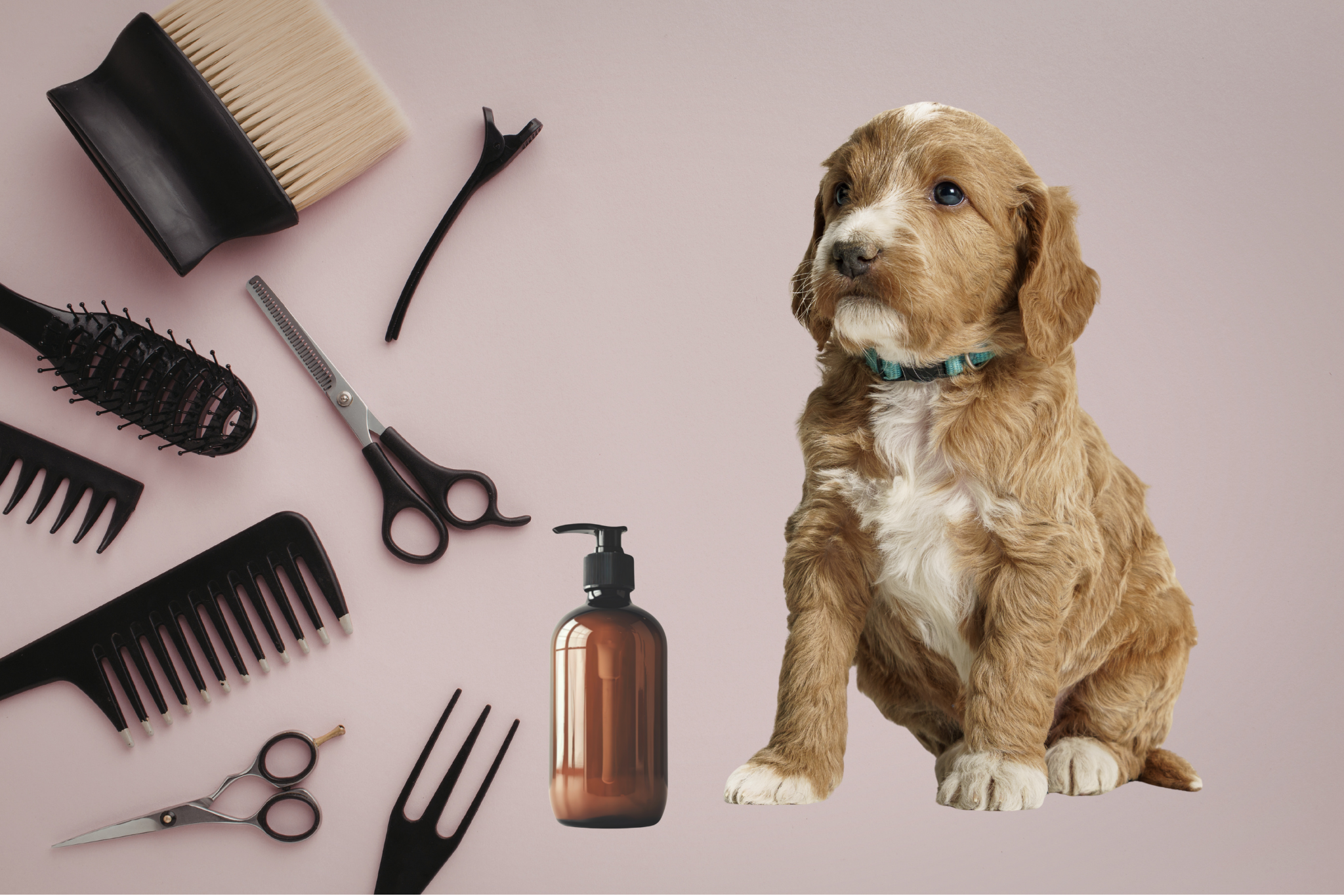
You brought home a living, breathing teddy bear. Your Goldendoodle is a bundle of fluffy joy… until you discover that first stubborn knot behind the ears. Suddenly, that beautiful coat seems less like a feature and more like a full-time job. If you feel overwhelmed by constant tangles and confused by the wall of grooming tools at the pet store, you are not alone.
What many owners quickly learn is that this isn’t just a cosmetic issue. For a Doodle, a simple tangle can escalate into goldendoodle matted fur, a tight, painful mass that pulls constantly on their sensitive skin. Professional groomers will tell you these mats can hide sores, restrict blood flow, and make every movement uncomfortable for your dog. Proper goldendoodle hair care is truly a matter of health and comfort.
Fortunately, you don’t need an entire aisle of products to win this battle. The secret to successful at-home goldendoodle grooming isn’t buying more tools—it’s buying the right ones. With just a few essential items and the correct technique, you can prevent painful matting for good and turn a frustrating chore into a relaxing bonding experience.
Why Your Goldendoodle’s Coat Isn’t ‘Fur’—And Why That Changes Everything
One of the first things new Goldendoodle owners learn is that their dog has “hair,” not “fur.” While it sounds like a small difference, it’s the single most important factor in their grooming needs. Most dogs, like Labradors or German Shepherds, have fur that grows to a set length and then sheds out. Your Goldendoodle’s coat, inherited from its Poodle ancestry, is different. It’s hair that grows continuously, just like the hair on your own head, and doesn’t shed in the same way.
This creates a perfect storm for tangles. While your Doodle might not leave piles of hair on the couch, the individual hairs do still die and detach from the skin. Instead of falling out, they get caught in the surrounding web of long, curly, or wavy hair. Every bit of friction—from a collar, a harness, or even just a good roll in the grass—works this trapped hair into knots. These small knots quickly grow into the tight, painful mats that Goldendoodles are famous for.
This distinction between hair and fur is precisely why the grooming tools and techniques that work for other dogs will fail for your Doodle. You aren’t just brushing to make the coat look nice; you are performing essential maintenance to remove that trapped undercoat before it can cause a problem. To do that effectively, you need a specific set of tools designed to reach the skin without causing discomfort.
The Brushing ‘Holy Trinity’: Your Must-Have Tools for a Healthy Coat
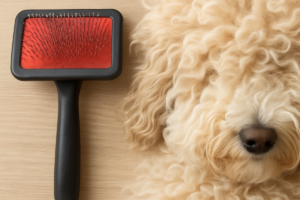
Stepping into the grooming aisle can feel overwhelming. With dozens of brushes promising perfect results, how do you choose? Thankfully, for a Goldendoodle, you can ignore almost all of them. Your entire mat-prevention strategy relies on just two core tools, starting with your workhorse: the slicker brush. These brushes have a flat or curved head packed with fine, angled wire pins. This is the best brush for a curly Goldendoodle coat because it’s designed to grab loose, trapped hair and gently break apart the small, surface-level tangles that form throughout the day.
Your second, equally crucial tool, might look simple, but its job is critical. It’s a sturdy steel comb, often called a “greyhound comb.” You must not think of this as a finishing or styling tool; it’s your diagnostic tool. After you’ve brushed an area with the slicker, the comb’s job is to go back through that same section of hair, all the way to the skin. If it glides through smoothly, you’ve successfully removed all the tangles. If it snags, you’ve found a hidden knot that the slicker missed.
It’s a common mistake to use only a slicker brush. This often leads to what groomers call “tip brushing”—where the top layer of hair looks beautifully fluffy, but a web of tight mats is secretly forming against the skin. These two tools are designed to be used as a team. The slicker brush does the initial heavy lifting, and the steel comb acts as your quality control, ensuring no tangle gets left behind.
These two items are the non-negotiable foundation of your entire at-home grooming kit. Owning and using them correctly is the single biggest step you can take to prevent painful mats and avoid a surprise full-body shave at the groomer’s.
How to Brush Like a Pro: The “Line Brushing” Technique That Prevents All Mats
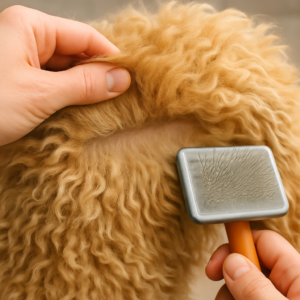
Having the right tools is only half the battle; they must be used with the right technique. The single most effective method, and the secret that professional groomers use, is called line brushing. The goal is simple but crucial: to ensure you are brushing every strand of hair from the skin to the tip, leaving no opportunity for a hidden mat to form. This at-home goldendoodle grooming guide will show you exactly how to do it.
Think of it like systematically parting your dog’s hair. Start on a section like the back or side, and follow these steps:
- With one hand, grasp a section of your Doodle’s hair and hold it up, exposing a “line” of the coat underneath, right near the skin.
- Using your other hand, take the slicker brush and brush the hair below your hand, using gentle strokes that move down and away from the skin.
- Once that line feels tangle-free, glide your steel comb through it. If it moves smoothly, you’re done with that line. If it snags, brush the spot again.
- Move your hand up about an inch and repeat the process on the next “line” of hair, working your way up the section.
This method is the ultimate answer to how to prevent matting in goldendoodle fur because it forces you to see and feel what’s happening at the skin. It’s especially critical for those notorious high-friction spots like under the collar, behind the ears, and in their “armpits.” By working in these deliberate lines, you guarantee a thorough job every time, keeping your dog comfortable and truly mat-free.
Bath Time Done Right: Why a Special Shampoo is Your Secret Weapon
After a thorough brushing, a bath seems like the logical next step. While it’s tempting to reach for whatever shampoo is in your shower, using human shampoo on your dog is a common but significant mistake. Human skin is naturally acidic, while your dog’s skin is much more neutral. This difference in what’s called “pH balance” is critical. Using human shampoo on your dog’s coat strips away its natural protective layer, leaving the skin vulnerable to dryness, irritation, and intense itching.
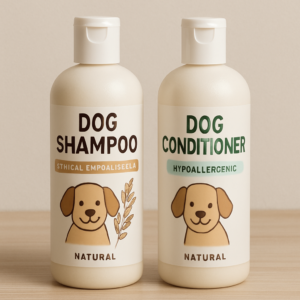
To avoid this problem, look for a high-quality, dog-specific shampoo designed for moisturizing. The best shampoo for goldendoodles with sensitive skin will often feature natural, calming ingredients. Formulas with oatmeal and aloe vera are fantastic choices, as they clean the coat effectively while soothing the skin and locking in moisture. The core hypoallergenic dog shampoo benefits are that they work with your dog’s biology, not against it, keeping them comfortable long after the bath is over.
Even with the perfect product, bathing too frequently can cause problems. So, how often should you bathe a goldendoodle? A good rule of thumb is about once every four to six weeks, unless they’ve had a particularly muddy adventure. This schedule helps maintain their skin’s natural oils, preventing the dryness that leads to scratching. Once your dog is clean and rinsed, you’ve set the stage for preventing future tangles.
The Unsung Hero of Grooming: Why Conditioner is Non-Negotiable for Doodles
If you think shampoo is the end of the bath-time story, you’re missing the most important chapter. Every strand of your Goldendoodle’s hair is covered by a protective layer called the hair cuticle, which is made of tiny, overlapping scales. Bathing, even with the best shampoo, can cause these scales to lift, creating a rough surface that loves to snag on neighboring hairs. Conditioner’s main job is to smooth these scales back down, creating a slick surface that helps prevent tangles before they even start.
This brings up a common question: can you use human conditioner on a dog’s hair? While it seems logical, it’s a bad idea. The problem isn’t just pH balance; it’s residue. Human conditioners are heavy and designed to be rinsed from our much less dense hair. On a Doodle’s thick coat, these formulas are nearly impossible to wash out completely. The sticky film left behind actually attracts dirt and makes the hair clump together, leading to the very mats you’re trying to prevent.
Investing in a quality dog conditioner is a core part of any effective goldendoodle grooming guide. Whether you use a rinse-out formula after shampooing or find that the best leave-in conditioner for doodle coats works for you on damp hair, you are fundamentally changing the texture of the coat for the better. This simple step makes brushing easier, reduces painful pulling, and acts as your first line of defense against the daily wear and tear that leads to knots.
Everyday Maintenance: Using Detangling Sprays and Handling Small Knots
Beyond the bath, daily brushing is where the real battle against tangles is won. A good detangling spray is your secret weapon here. Think of it as a daily leave-in conditioner that gives the hair “slip,” a term groomers use to describe a silky texture where strands glide past each other instead of grabbing and knotting. A light mist of detangling spray for dogs before brushing helps your slicker brush move through the coat with less pulling, making the experience more comfortable for your Doodle and preventing friction-based tangles before they form.
When you do discover that inevitable small knot, resist the urge to attack it with your brush. Instead, follow a simple method that offers one of the best goldendoodle matted fur solutions at home. First, saturate the small knot with the detangling spray and let it soak in for a minute. Next, use your fingers or the tip of your steel comb to gently pick the knot apart, working from the outside edges inward. Once it’s loosened, you can then use your slicker brush to smooth the hair out completely.
This technique is perfect for small, new tangles, but it’s crucial to know your limits. Here’s one of the most important professional groomer tips for doodles: if a knot is tight against the skin, larger than your thumbnail, or you can’t easily get a comb between it and the skin, it’s a true mat. Never try to cut these out with scissors, as the risk of injuring your dog’s skin is extremely high. These severe mats require a groomer’s expertise. Knowing how to handle these daily finds—and when to call for backup—is the key to a successful routine.
Your Doodle’s Weekly Action Plan for a Flawless, Mat-Free Coat
That overwhelming wall of grooming tools at the pet store no longer seems so intimidating. You’ve moved past the confusion of tangles and mats, and now you understand exactly how to care for a Goldendoodle coat. Armed with a slicker brush and a steel comb, you have the knowledge and the core equipment to keep your dog’s signature fluff healthy, comfortable, and beautiful.
Making this knowledge a habit is the final step. To turn this from a big task into a simple routine, follow this easy Goldendoodle grooming schedule:
- Full Body Brush-Out (15-30 min, 1x/week): Use the line brushing technique with your slicker brush. Go over your work with the steel comb to ensure you haven’t missed any hidden tangles.
- Spot Check (5 min, 2-3x/week): Quickly brush high-friction spots like behind the ears, under the collar, and in their ‘armpits’ where mats form first.
- Post-Adventure Care (As needed): Always brush after swimming or running through fields to remove debris and stop tangles before they set.
By committing to this simple schedule, you transform grooming from a dreaded chore into a consistent act of love. You’re no longer just fighting mats; you’re building a stronger bond, ensuring your dog’s health, and paving the way for more compliments from the groomer. Best of all, you can look forward to years of happy, tangle-free cuddles with your fluffy best friend.


